


Written by: Eric Astle, Nation Branding Assistant | Content supervised by Christian Ángel, Creative Director & Nation Branding Strategist, brandlond
On 26th September at Wembley Stadium, Spain stepped onto English soil wearing their second World Cup star for the first time. This landmark moment unified the men’s EURO 2024 and World Cup 2026 with the women’s World Cup 2023 victory, solidifying Spain as the dominant power in world football. Global sporting events are not mere spectacle though. Nation branding relies on soft power: the ability to earn trust, admiration, and influence through cultural prestige rather than economic leverage alone. Beyond the pitch, global sporting triumphs generate organic international admiration and cultural capital. Spain’s second star is much more than a sporting accolade; it stands as a high-profile symbol of the country’s broader institutional, cultural, and economic vitality.
This milestone is key to Spain’s changing brand perception in the UK. Historically framed through the lens of tourism, hospitality, and lifestyle, the UK’s view of Spain has shifted over the past two decades. During this time, Spanish enterprises integrated directly into the British economy: Santander embedded itself in British banking through Abbey National (2004); Telefónica anchored communication by acquiring O2 (2005); and Iberdrola positioned Spain as part of the UK’s green energy transition via ScottishPower (2007). Today, Spain powers critical UK infrastructure. Whilst Spain’s football success did not create this commercial reality, it provides emotional validation for it, reinforcing Spain’s identity in the UK from a favoured leisure destination to a benchmark of technical precision and execution at scale.
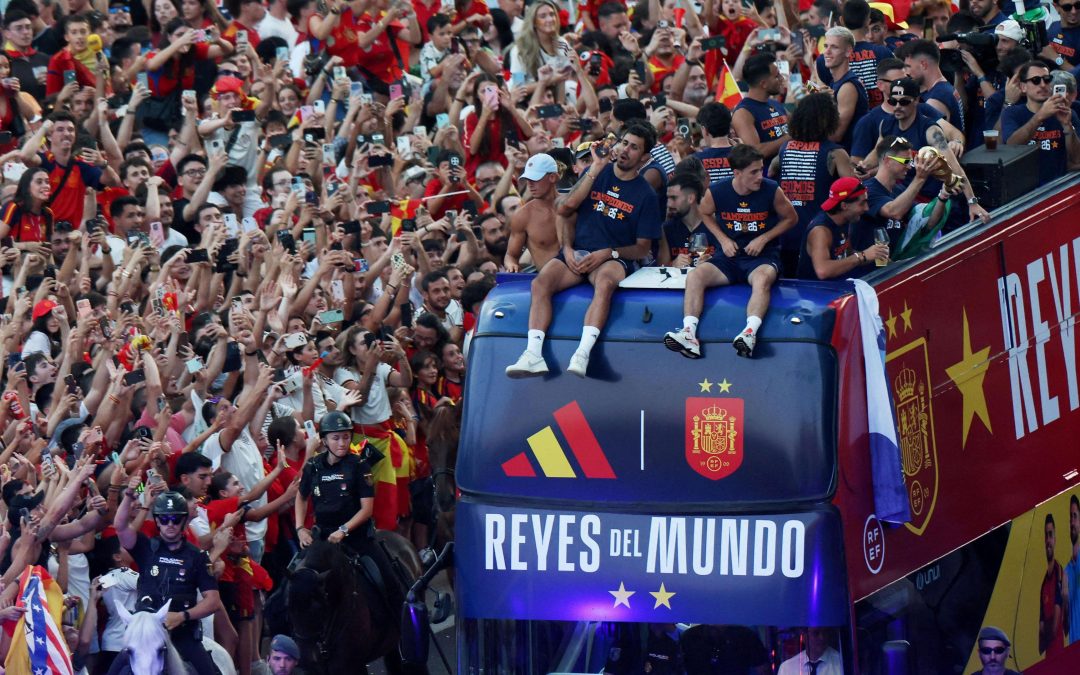
Spain’s football players act as cultural ambassadors. The team’s football playstyle, built on structural discipline and fluid ball circulation, creates an identity anchored in intellect and strategy rather than just passion. The integration of young talent like Lamine Yamal and Pau Cubarsí demonstrates an environment that fosters innovation and sustainable talent pipelines. This ambassadorial role extends beyond match play into celebration. Whilst global sporting triumphs are often defined by lager spraying and champagne popping, Ferran Torres sipping wine on the World Cup parade bus offered a distinctly Spanish image: wine connotes sophistication, regional heritage, and craftsmanship. Pairing that visual with an elite modern athlete creates a powerful metaphor for the duality of modern Spain, grounding world-class performance in authentic Mediterranean culture.
Beyond the international stage, Spain’s soft power operates on a weekly basis through its star players competing at the highest levels of club football. In the Premier League, players like Rodri, Merino, Zubimendi, and Raya have displayed tactical intelligence and consistency, and managers like Pep Guardiola and Mikel Arteta have reshaped modern football through controlled possession and fluid passing. Together, they function as year-round Spanish brand ambassadors embedded in British culture. Club football’s weekly exposure builds a subconscious association between Spanish leadership and long-term reliability. Their sustained success generates organic relational trust with UK fans and corporate leaders.
Spanish companies expanding overseas do not simply export products and services, they export values. The attributes that define Spain’s World Cup victory (strategic patience, collective intelligence, and global competitiveness) are precisely those required to succeed in global commerce. Spanish businesses operating in the UK can leverage this athletic prestige. By aligning corporate storytelling with the national team’s pursuit of excellence, companies can convert sport-driven emotional value into commercial trust. When a nation consistently outperforms the competition on the world’s most-watched stage, its businesses gain an implicit endorsement; an inherited assurance of quality and modern leadership. For Spanish enterprises operating across the UK, the national team’s World Cup victory acts as a catalyst, giving the Spanish brand a competitive edge when forging partnerships in the UK market.
Sporting success opens the door to global admiration, but corporate excellence delivers on its promise. As Spain enjoys their recent victory at Wembley, the country enjoys a period of unprecedented soft power and brand prestige across the UK. However, an enhanced nation brand is not a passive asset; it is an active catalyst. For Spanish enterprises in the British market, this moment offers a unique window of opportunity. By aligning corporate narratives with the values that define Spain’s football success, businesses can convert national pride into commercial trust and enduring commercial partnerships