

Written by Raquel Barrera, from diversitas institute.
Same country. Same achievement. Two very different experiences of belonging.
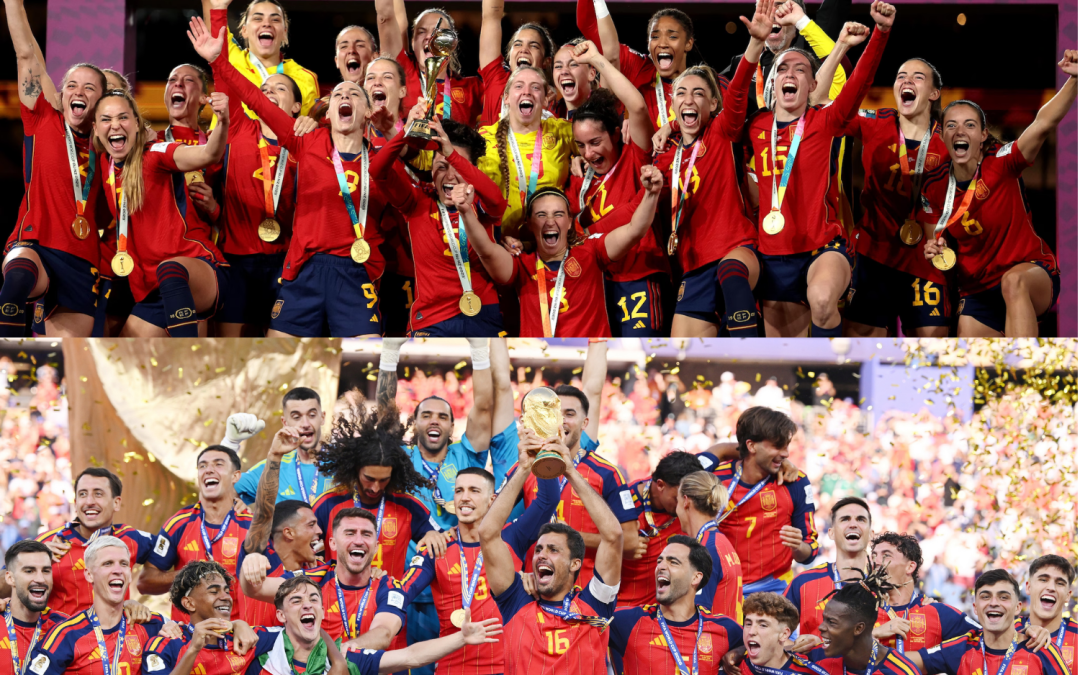
In July 2026, Spain became the first country ever to simultaneously hold the men’s and women’s World Cups at the same time. Spain’s women lifted the trophy in 2023; the men followed in 2026. One country, two teams, two trophies, three years apart.
When I was asked to write about the role of diversity in that success, my first instinct was the tempting one – and the easiest: Spain’s national teams reflect an increasingly diverse and multicultural society. Spain won, therefore diversity must be a competitive advantage.
Obviously, it is not that simple, and any reader would be right to challenge and reject this conclusion. Sport is part of our society and diverse teams reflect this reality. But representation alone is not necessarily proof of success.
Does bringing together different backgrounds, experiences and perspectives make a team more successful? Or does it only do so when people feel valued, respected and able to contribute?
The more rigorous answer to these questions requires a more nuanced view. Diversity is a necessary condition, but it is not sufficient on its own. It can be perceived as purely decorative and tokenistic. The value of diversity emerges when it is paired with real inclusion: when different perspectives are heard and valued, when leaders are willing to change or adapt the system rather than expecting individuals to change or adapt themselves, and when organisations create the conditions for people to be themselves and to thrive.
The contrast between Spain’s two victories is remarkable. Both teams won, but they lived different experiences.
That contrast is the starting point for this article. Not to claim that diversity was the main driver of Spain’s victories (it was not) but to explore what these two stories can teach us about the relationship between diversity, inclusion and performance, in sport and beyond.
When a team is a reflection of society
A national team is, in many ways, a reflection of the country it represents, and Spain is no exception.
Its football teams bring together players from different regions, cultures, and socio-economic backgrounds. Yet when they put on the national shirt, those differences become part of a shared identity: they represent the same country and pursue a common goal.
Representation, however, is only the starting point: a team can be diverse without being inclusive. Having a diverse group of people working together does not automatically mean that everyone feels respected, valued or able to participate. People need to feel that they belong; that their uniqueness is not something they have to leave at the door, but something that can contribute to a collective objective.
This same principle applies to business: a diverse workforce can bring different experiences, perspectives and ways of approaching a problem. But the potential value of that diversity is only effective when people are encouraged to speak, participate, collaborate and contribute. Inclusion creates the conditions in which different perspectives can challenge assumptions, fuel creativity and foster innovation, bringing organisations closer to their customers and communities.
The goal of inclusion in diverse teams is not to make everyone feel the same. It is to make everyone feel that they belong to the same team and can contribute to a common goal.
The inclusive leader: creating the conditions to succeed
An inclusive leader does more than bring different people into the room. They create an environment in which people can feel safe and empowered to speak up, challenge a decision, collaborate and contribute. An inclusive leader recognises that not everyone enters an organisation from the same starting point and that treating everyone identically does not necessarily produce an equal experience. It’s not about providing the same resources and tools for everyone. It’s about ensuring everyone has the same opportunities to succeed.
And this is where leading by example becomes critical. A culture of inclusion is not created by what leaders say, but by what leaders consistently do. Inclusion is experienced through behaviour.
The experience of Spain’s men’s and women’s national teams provides an interesting lens through which to explore this idea.
The men’s victory in 2026 can be seen as the story of a talented and diverse team operating with the support of an established sporting structure, leadership and resources around it.
The women’s victory in 2023 presents a more complex story, showcasing what happens when sporting success coexists with failures of leadership and protection. Their extraordinary sporting achievement was quickly overshadowed by the events surrounding the World Cup final, which triggered a much wider conversation about consent, sexual harassment, culture and power.
That contrast matters because it reminds us that performance and inclusion can coexist but they are not the same thing. Results tell us what a team or organisation achieved. They do not necessarily tell us how people experienced the journey, whose voices were heard, who was protected, or what behaviours were tolerated along the way.
The same applies to business.
We should not assume that successful organisations necessarily have healthy cultures, or that high-performing teams are automatically inclusive teams. Performance and inclusion can reinforce each other, but one should not be used as evidence of the other.
What we can say is that diverse perspectives, inclusive cultures, psychological safety, equity and accountable leadership can create the conditions in which people are more able to contribute, challenge, innovate and perform over the long term.
And perhaps that is the broader lesson from Spain’s two World Cups.
Building a winning team is not only about having different talented individuals. It is about creating the conditions in which those individuals can succeed together.
Because, in business as in life, how we win matters as much as what we win.